
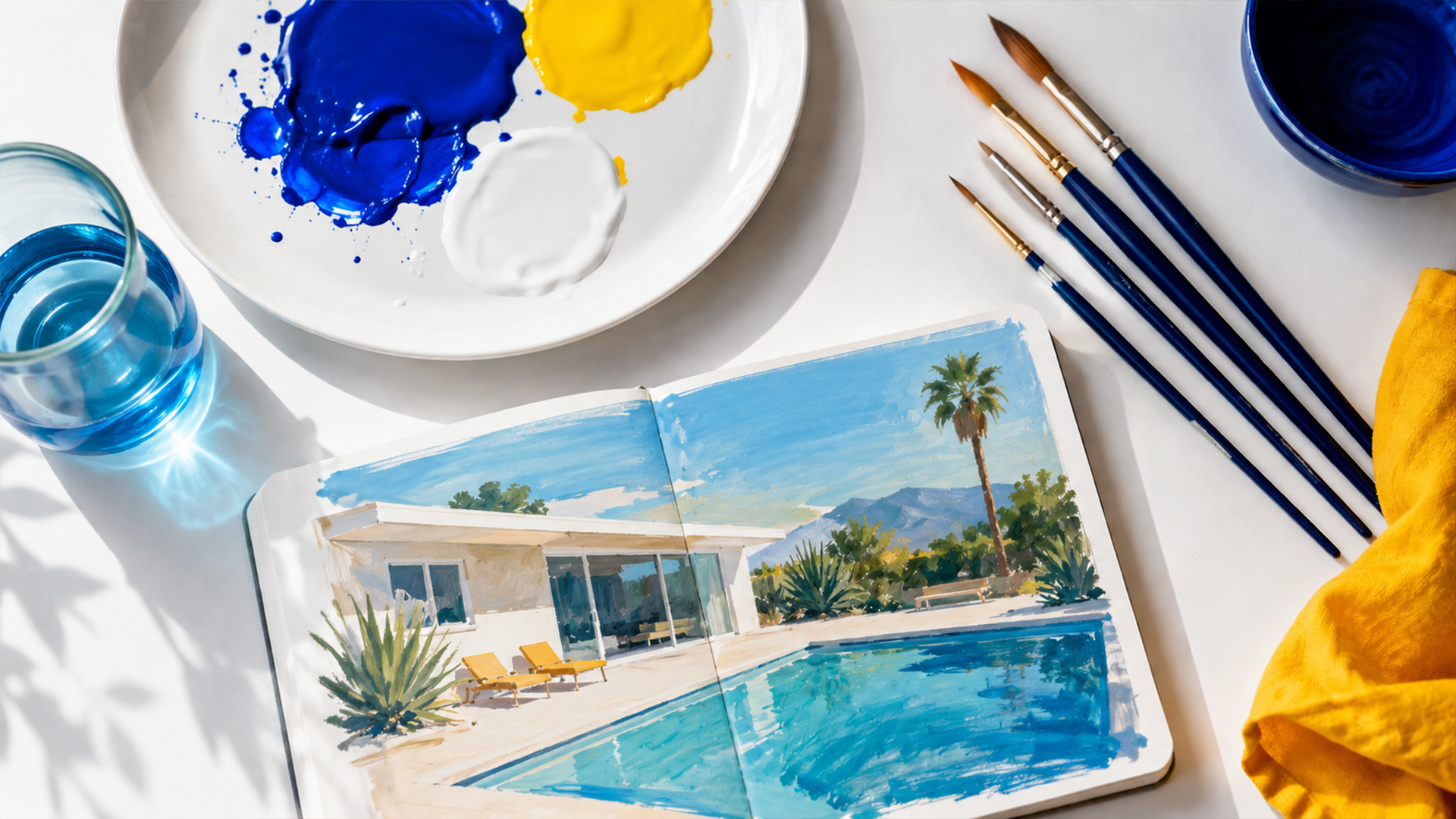
David Hockney, who passed away on 11 June 2026 at the age of 88, was one of the most important and widely loved artists Britain has ever produced. Over a career spanning more than six decades, he painted, drew, photographed, printed and digitally created his way through an extraordinary body of work – always curious, always evolving, and always unmistakably himself.
Bradford to the Royal College
Hockney knew he wanted to be an artist from the age of eleven. Growing up in a working-class family in Bradford, West Yorkshire, he was supported by his parents – who would go on to become recurring subjects in his work – and won a scholarship to Bradford Grammar School before studying at Bradford School of Art. He graduated with first-class honours in 1957 and sold his very first painting, A Portrait of My Father, that same year.
In 1959 he moved to London to study at the Royal College of Art, where he graduated with a Gold Medal – the highest distinction available. It was there that his reputation began to form, and where he first emerged as one of the most exciting young painters of his generation.
California and the swimming pools
In 1964 Hockney made his first extended visit to Los Angeles, and the city changed everything. The light was unlike anything he had experienced in England – sharp, flat, bleaching – and it gave him a new visual vocabulary. He began documenting the city’s sun-drenched surfaces and its culture of leisure, and it was here that he produced the works that would define him in the public imagination.
The swimming pool paintings – A Bigger Splash, Peter Getting Out of Nick’s Pool, Portrait of an Artist (Pool with Two Figures) – remain among the most recognisable images in contemporary art. What made them remarkable wasn’t just their technical brilliance but their mood: a kind of warm, slightly melancholic stillness that felt both glamorous and intimate at the same time. He settled permanently in Los Angeles in 1978, though he never stopped returning to England.
A painter of people and places
Throughout his career, Hockney returned again and again to the people he loved. Portraits of his parents, his friends, his assistants and himself appear across decades of work. He used his sketchbooks as a visual diary and kept those closest to him at the centre of his art. His double portraits in particular – large, carefully composed paintings of couples in domestic settings – show an artist deeply interested in human relationships and the quiet dynamics between people.
He was equally drawn to landscape. The Yorkshire Wolds, where he spent extended periods later in his career, inspired some of his most ambitious work – vast, multi-canvas paintings of fields and trees across the changing seasons, full of colour and movement. His Bigger Trees Near Warter, a monumental work painted on location across 50 canvases, was donated to the Tate and remains one of the largest paintings in their collection.
Never standing still
What distinguished Hockney from many of his contemporaries was his restless curiosity about how we see and how images are made. In the 1980s he became deeply interested in photography – not as a replacement for painting, but as a way of exploring perspective. His photocollages, which he called “joiners”, assembled dozens of photographs into fragmented, Cubist-influenced images that questioned the single fixed viewpoint of the camera lens.
Later, he turned his attention to the fax machine, the laser printer, and – most famously – the iPhone and iPad. Where others might have seen these as unsuitable tools for serious art, Hockney embraced them with the enthusiasm of someone who had always treated new technology as an invitation rather than a threat. His vast iPad painting A Year in Normandie – 90 metres long, made up of 220 panels depicting the seasons changing in his French garden – was exhibited at the Serpentine in London earlier this year. He was 88 years old and still producing work of genuine scale and ambition.
What his legacy means for design
For anyone working in the creative industries, Hockney’s career offers several lasting lessons.
Colour is never neutral. Hockney used colour with extraordinary intention – not to decorate, but to create feeling. Every blue in those California pools was chosen to carry light and heat. That kind of deliberate thinking about colour is something every designer can learn from.
Simplicity is the hardest thing to achieve. His most celebrated paintings look effortless. They are not. The clarity and confidence of his compositions is the result of deep technical knowledge and endless refinement. When design looks simple, it’s usually because someone worked very hard to make it so.
Embrace new tools. Hockney never dismissed a new medium simply because it wasn’t traditional. He asked what it could do that other tools couldn’t, and then he pushed it as far as it would go. That’s a useful attitude for any creative practitioner navigating an industry that keeps changing.
Curiosity is a career. Hockney spent over 70 years asking questions about how images work, what painting can do, and how we experience the world visually. He never stopped learning. That sustained curiosity – more than any single painting or technique – is perhaps his most inspiring legacy.
There will never be another David Hockney. But the way he approached his work – with joy, with rigour, with an absolute refusal to stand still – is something worth carrying forward.
David Hockney, 9 July 1937 – 11 June 2026.